How to Have a Great First 5K
A guide for anyone standing at the starting line for the first time, wondering what they got themselves into.
Racing is one of the most vulnerable things you can do. They’re going to attach a number to your name, it’s kind of written in stone, and everyone can see whatever you do. That’s a truly brave act. If you’re thinking about signing up for your first 5K, or you already have and you’re starting to feel the nerves creep in, I want you to know that first. You’re doing something brave.
Table of Contents
That said, the 5K is about the lowest barrier to entry in all of racing. Everything you’ve heard about carbo loading and hydration vests and fueling strategies during the race, that’s real stuff, but it’s for the half and the full marathon. For a 5K, if you can run a mile, you’re honestly not far off. Many people take walk breaks and there’s nothing wrong with that. The worst case scenario is you run for five minutes and walk for forty. You’re not going to get hurt, they’ll wait for you, and you’re still going to get a medal. The consequences are really low. A lot of people are much more mentally not ready before they’re physically not ready.
So if you have any interest at all, my advice is to just go do one.
Get There Way Earlier Than You Think
This is the one I’m basically famous for harping on. The setup process is different at every race, and things go sideways constantly, especially at the local level. Sometimes there’s one person working an iPad for bib pickup and there’s a line out the door. Sometimes they don’t rent enough bathrooms. Sometimes parking is a disaster and you’re walking a mile to the start.
Getting there early is the buffer that lets you roll with all of that without it wrecking your head before you even cross the start line.
My personal number is two hours, which I know sounds insane. For most people I push for 90 minutes. Absolute minimum is an hour. You need time to get your bib on, make sure everything’s in order, do your warmup, and use the bathroom. That last one alone can take 30 minutes if the lines are what they usually are. And if you’re in line with 10 minutes to go, sometimes it’s literally impossible to get in. Don’t let that be your story from race one.
The Warmup
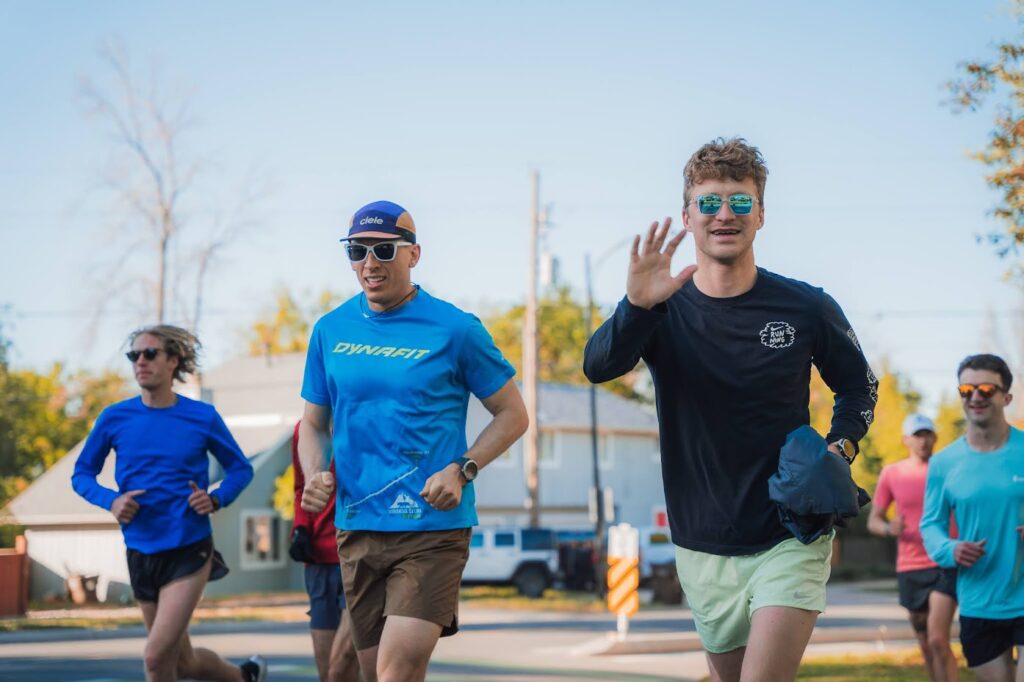
For a marathon, we don’t do much. Maybe five minutes of easy jogging and a little mobility work. A 5K is different. It’s a short, fast, intense event, and if you’re running anywhere close to 20 minutes or under, your body needs to be firing before the gun goes off.
The closer you get to that faster end of the spectrum, the more warmup structure matters: a longer easy jog, some hard strides to get the heart rate up and the legs turning over quickly. Even if you’re not there yet, a few minutes of easy running and some movement beforehand will make the first mile feel a lot less brutal.
Do your warmup early. Get your bathroom stop done early. Do everything early.
Don’t Get Lost in the Fueling Weeds
When I worked at a running store in college, someone came in and grabbed ten gels and asked how many they should take for their 5K. I get it. You hear about fueling, you see people with vests and hydration packs, and it all seems like part of the sport. But for a 5K you won’t even dip into your carbohydrate stores. You’re going to be out there for somewhere between 20 and 45 minutes. You don’t need fuel during the race.
What you do want: good hydration going in, water with electrolytes in the days before, a solid breakfast that morning. Just don’t overthink what happens during those 3.1 miles.
Start Slower Than You Think You Need To
This might be the most important thing I can tell you, and it’s also the hardest one to actually do.
The start line of a 5K is an electric place. There’s music blasting, a thousand people packed together, and someone’s about to fire a gun. Your adrenaline is going to spike whether you want it to or not. Everything in your body is going to want to go.
Don’t.
The first five minutes are the most important. If you can be reserved, slower than you think you need to be, running what feels like your easy day pace, and just take everything in, you’ll be setting yourself up for a completely different kind of race. The classic mistake is blasting off the line and then slowly fading the whole way, feeling worse at every mile marker. That’s a miserable experience. It happens to almost everyone on their first one.
If instead you hold back early, halfway becomes an exciting moment. You check in, you realize you have something left, and you can start to push. Moving through the field in the second half instead of getting passed by everyone feels completely different. It’s empowering. You can make up all that time and more.
Starting further back in the corral can actually help with this, by the way. It naturally slows you down and keeps you out of the chaos up front.
If you want a rough effort guide: think about starting at around a 4 or 5 out of 10. Easy day feel. Then at the halfway point, check in. Can you take it up a notch? Then again with about a mile to go. At that point, there’s less bad that can happen even if you go for it. Give it everything you’ve got for that last mile.
The Running Community Will Surprise You
If you haven’t experienced it yet, you’re in for something. The volunteers, the race organization, your fellow runners, 99.999% of the time everyone is uplifting and welcoming. It’s one of the things that gets people hooked. You show up nervous and a little unsure, and you leave thinking, okay, when’s the next one?
If you can go with someone who has done it before, do it. You’ll quietly learn how they handle the warmup, the corral, all the logistics. You’ll feel less alone in the unfamiliar parts. There’s a reason people get into this thing and never leave. Part of it is the running, but a big part of it is that community.
And for what it’s worth, I’ve coached a lot of people through their first race, and I’ll tell you the same thing I tell all of them: I’ve seen a lot of people do this, and you’re going to run better than you think you will.
A Few Etiquette Notes
Don’t line up at the very front of the corral if it’s your first one. The front of the pack moves very fast and you’ll either go out way too hard trying to keep up, or you’ll be in the way of people who’ve been chasing a PR for months. Find a spot that matches your comfort level.
You generally don’t need to stop at water stations for a 5K, but it’s not a big deal if you do. The race is short enough that it won’t cost you much.
If You’re Nervous About Whether You’re Ready
Let me reframe that question a little. The 5K is designed to be accessible. You’re not going to hurt yourself. Nothing bad is going to happen. The running community is going to be rooting for you. And the moment you finish, you’re going to be thinking about the next one.
The courage it takes to show up is real, and I don’t want to minimize that. But I’ve never met someone who finished their first 5K and said they wished they’d waited longer. Usually it’s the opposite.
Get out there.