

How Often Should You Fuel on Runs? (Most Runners Wait Too Long)
You should start taking in fuel during runs that are 90 minutes or longer.
Does this include interval workouts, quality sessions, and other types of faster workouts?
YES. The demand for carbohydrates as fuel goes up with intensity. It’s even more important to fuel during these faster, longer runs.
Table of Contents
What should I be fueling with?

Good question. Lately, I’ve been using a combination of NeverSecond, Huma, and Untapped gels. I’ve tried almost every brand out there and have landed on these. It’s a combination of taste, how well they go down, and then waiting to see if your stomach can handle them for long periods. I like these options for gels because they have a more water-like consistency than a normal GU gel, so your mouth won’t get dry. Both are around 30g of carbs. So 1 every 30 minutes gets you to 60g of carbs an hour, which is an adequate place to be. BUT fueling and nutrition are very personal. There might be better options for you. Try some different products out! Every athlete I work with gets a discount at The Feed. It’s an incredible place to start. They almost always have a try-out pack that features a bunch of popular brands of gels, so you can start to see the differences in tastes and textures. This is important because it’s rare for athletes to stick with one product for their whole career. Athletes often use multiple types of gels or products during one race or run. Why? Well, after eating a large number of anything, it’s quite common to get tired of it and crave something different. If you don’t have a second option, you might not take in as much fuel as you need for optimal performance.
It’s quite common to experience fatigue from consuming the same gel for an extended period. It’s a good idea to have a variety of flavors, brands, and types of fuel to keep things interesting and balanced.
Do I have to use gels?
No, but there are reasons most people do.
The biggest reason is that you don’t have to chew gels! Chewing takes time and energy. Taking in all your fueling needs through liquids alone is much more difficult. It’s possible, and elite marathoners try to do it, but they usually don’t run more than two hours. They also have bottle service at every race. Most runners will not. You could carry all of that in a pack or hydration belt, but that extra weight will not be fun to carry around. A lot of runners utilize a combination of gels, energy chews, waffles, bars and various other snacks. There are a lot of different creative things to try out when it comes to that. Just make sure you’re practicing those other items MONTHS before the race you’re training for.
Liquid Fuel vs. Gels, and Why Specificity Matters
One important thing to think about with fueling is whether you’ll actually be able to use the same setup on race day. A lot of runners train with liquid calories because it’s convenient and easy on the stomach. One nice thing about liquid fuel is that it combines hydration and calories in one place. You’re drinking and fueling at the same time, which simplifies things. You’re not constantly thinking, “Did I drink? Did I take a gel?” It’s all happening together.
But there’s a downside to that, too. When hydration and calories are tied together, stomach issues can become a bigger problem. If your stomach starts feeling off and you stop drinking as much, now you’re also cutting your calories. And if you back off the calories, you’re probably backing off fluids too. So one small issue can turn into two problems pretty quickly. Low carbs and low hydration at the same time is not where you want to be late in a race.
In training, liquid fuel can work great. You can carry bottles, use a vest, refill easily, and control everything. But most marathons don’t work like that. Unless you’re an elite with bottle service, you’re usually limited to cups at aid stations. That’s why most runners end up relying heavily on gels in races, whether they planned to or not.
Some runners will carry a bottle for the first hour of a marathon, which can be a solid strategy. Others try to set up handoffs with friends or family along the course. That can work, but it’s harder than it sounds. People miss you. You miss them. Crowds get in the way. Aid stations get chaotic. Even with a great plan, things can fall apart.
So no matter how “perfect” your bottle strategy is, you should always have backup gels. Always. If a handoff fails or a bottle gets dropped, you still need a way to get carbs in. That’s just smart risk management.
For most runners, it ends up being one of three options: start with liquid and switch to gels, use mostly gels from the start, or use a combination of both. None of these are wrong. But whatever you choose, you need to practice it in long runs.
If you’re going to race with gels, you need to be practicing with gels now. If you’re going to start with liquid and transition, you should be rehearsing that transition. Fueling is specific. Your gut, your habits, and your timing all adapt to what you practice. Race day is not the time to try something new.
For ultras, this looks very different. Carrying bottles is normal. Aid stations are frequent. Refills are everywhere. That makes liquid calories much more realistic and often a bigger part of the plan. In that environment, relying more on fluids can make a lot of sense.
How often should I be fueling during runs?
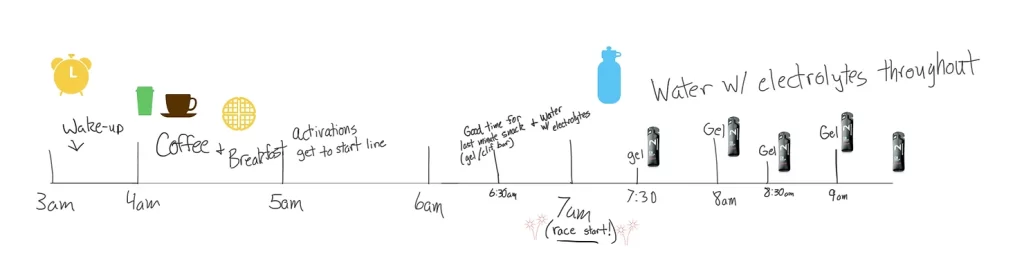
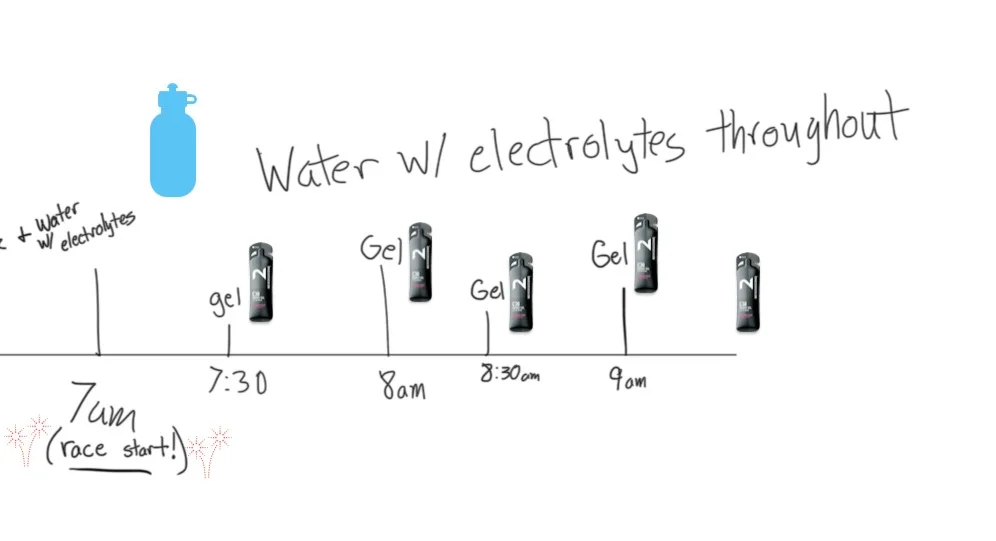
Somewhere around every 30 minutes. It could be 25, it could be 40. The longer you take in between fueling, the harder it will be to get in enough carbohydrates for optimal performance. If a gel every 30 minutes feels like too much on the stomach, move the interval out until you have less GI distress.
How many carbohydrates do I need per hour, to run at the full capabilities of my fitness?
More. Here’s the deal. I’ve read almost every study on carbohydrate intake and endurance sports, and 99% of the time, they find that adding a little more carbohydrate dramatically improves performance. The limits to this are pretty much unreachable. Studies have found performance benefits of well over 100g of carbs an hour. There are very few folks who can run hard and take in 120g of carbs an hour. You will get uncomfortable, your stomach will hurt, and you’ll probably throw up. Not good. So, for us regular folks, we just want to get our numbers to nearly as high as we can without any stomach issues. 60g of carbs an hour is a solid starting out point. That’s a 30g of carbs gel every 30 minutes. From there, we can start to test if we can push that up to 70, 80, or even 90g of carbs per hour by shortening the interval between gels, adding in higher carbohydrate gels, or supplementing with a liquid carbohydrate mix. A lot of that depends on the logistics of what even we’re racing and many other factors. Somewhere between 60-90g of carbs an hour is where a lot of good performances happen.
But I’ve run A LOT of Long Runs with no fuel, and I was fine! Why do I need to add this in?! It feels like one more thing to think about!
You’re right. It’s not impossible to run 20 miles with no fuel or hydration. But it isn’t ideal and usually isn’t even safe. We can get away without fueling for some runs, especially 120 minutes and under, but I wouldn’t recommend it for several reasons.
One, it limits our performance. We want to run faster and stronger! We have a lot of studies that show runs utilizing carbs lead to better performances and times.
Second, if we practice our fueling before the event, we will be better prepared come race day. Did you know our stomachs can be trained? They can learn to handle certain types of fuel, and we can even train them to handle more fuel! But, just like running, we need to practice. Fueling during running draws blood and metabolic energy away from our heart, lungs, and legs and into the stomach to process the nutrients. We need to get more efficient at this. So we practice. Also fueling while running is kind of a skill! You have to learn how to store those gels, pull them out while running fast, open them up, try and extract the viscous slime that’s inside, and then dispose of the wrapper, all while running a marathon! It’s actually not that easy. So we need to practice it.

The last reason we need to be fueling during runs, even though it’s annoying, is that it will aid our recovery. We can be replenishing the muscle and glycogen stores before the run is even over. Just about everyone who starts fueling during the big runs and workouts will make a comment that it’s appeared to lead to better recovery. Running for hours and not fueling is really hard on the body. When we combine the stress of running for hours with the stress of our body thinking it’s being starved and desperately seeking calories, we are left with a recipe for disaster when it comes to recovery.
Okay, why about hydration?! How much should I be drinking, and what should I drink?
First, this topic is incredibly complex and drastically changes from event to event. A 40-degree marathon will have a significantly different hydration protocol from a 100k run in hot weather.
Let’s start with the marathon. It’s generally not wise to carry your own hydration because they have it on the course quite frequently. So, in this instance, you’re going to want to grab just about every available cup of water they have on course, usually the ones that have electrolytes.
If you’re in a race where you’re carrying your own hydration, a good starting out point is to get in 400ml of water with electrolytes an hour. For many people, it will be more, but this is not a bad place to start. Having at least a small amount of electrolytes in your water makes the fluid more absorbable in your body and helps prevent hyponatremia (where you have too much water and not enough electrolytes in your system).
What About Electrolytes?
Uhm what about them? jk jk. A lot of gels don’t have a ton of electrolytes in them. And electrolytes are CRAZY important for distance running. To combat this we want to do a few things. First, we want to be drinking an electrolyte mix the few days leading into the race to make sure our stores are all topped up. My favorite way is to take 2-3 servings of Skratch hydration spread out across the day the last 2-3 days leading into a race. Simple. Could even do gatorade if that’s your thing.
How Do I Know If I Need More Sodium?
Sodium is the one piece of fueling I tell athletes is the most individual. It’s not really a nutrient you can plan around the same way you plan carbs. Some people are not salty sweaters, and some people have way higher sodium needs on a run than the average person. You can get a sweat test done to measure this directly, but honestly, I haven’t found them all that helpful or worth the cost for most athletes.
The best way I’ve found to know if you need more sodium comes down to two things:
- You have an intuition. You’ve felt that heavy, crampy, foggy feeling late in a long run or race and suspected it was more than just fatigue.
- This is the big one: have you ever noticed white salty patches on your clothes or skin after a sweaty run, where you can actually see that white residue building up? That’s a really clear sign you should be experimenting with extra sodium in training.
There’s a company called Salt Stick that makes chews, pills, and gummies, all built to solve this exact problem, so you can take extra sodium in whatever form works best for you.

All three are affordable, easy to carry, and genuinely taste good, which matters more than people think when you’re trying to get something down late in a race. If you think you might be one of these higher sodium sweaters, try one of these in a couple of your next long runs or workouts and see how you feel. If you’re still not sure, a sweat test is out there as an option to get more data.
For a lot of runners, this makes a real difference, because most gels are pretty light on sodium. And in races, aid stations don’t always solve the problem either. The cups are small, they might not carry the electrolyte drink you like, and even if they do, it’s tough to get enough sodium from cups alone to race well. Carrying your own sodium source can be the difference maker, especially in hot conditions or in the back half of a marathon when things start to unravel.
Electrolytes During the Race
Once we’re in the race there’s a few things we can do to get some added electrolytes. WE want to almost always prioritize grabbing cups on course with STUFF in them. When I say STUFF I mean not plain water. Cups with Gatorade, Gatorade Endurance, Nuun, Skratch, etc etc etc. They have electrolytes and free calories! You will run faster if you drink these cups instead of just the plain water.
Next you might consider carrying a salt tab, salt pill, or some external electrolyte concoction of your own. Personally, I love these chews from Salt Stick. They taste like candy!!
Should I Keep Track of what I take in During the Run?
YES! You really should. I have this template where I have athletes write in every product so we can see how many carbohydrates, calories, and mg of sodium they took in per hour. You 100% should write down everything, so you have a log of what products you liked! As you start to learn your numbers, you will become an unstoppable long-distance running force! When you know how to fuel at a high level, your running will be elevated. You’ll run faster and recover quicker!
Okay, that’s all I got. Go try stuff out, and let me know what’s working for you!
Updated 9/24/25