
100%, without a doubt, you should use minutes.
Table of Contents
When we are training, most days are going to have a purpose and a reason. The focus we put on each day is going to line up with a physiological principle, most likely. Some days are meant to be recovery days. Some days are for endurance. Some days are for speed, and so on.
On easy days, I’ve run 10 miles in close to 60 minutes, or 1 hour. I’ve also had days where that 10 miles took me over 100 minutes, almost double. That’s a huge discrepancy in training stimulus. If I had a key workout the next day, I would not have wanted to run for almost 2 hours the day before. Where a 60 minute run would be normal and fine.
The Problem With Training by Mileage

Another reason we should all track our training in time over mileage, is that it extends the good days and shortens the bad ones. Say I’m assigned a 70 minute run. On the days I’m feeling FANTASTIC, that run could be 11 miles. If I’m feeling rough, not fully recovered, tired, and rundown, I might jog this run very easily. I might go at a 9 minute per mile pace and only cover 7-8 miles. An almost 4 mile gap from the day I’m feeling great. Which is EXACTLY what we want out of our easy recovery days. More distance on the days we feel great, and much less on the days we do not. If we use distance over time, we might be spending twice as much time on our feet on our worst, least recovered days. The days we are most likely to get injured. Hard pass.
The Social Pressure to Chase Miles
It’s very hard for some people to get out of the mindset of chasing mileage numbers. It’s much easier and more fun to tell people you ran 5 miles, not 40 minutes. We want to tell people we run 50 miles per week. I’ve seen many people get hurt because they needed to run 5 more miles to hit a weekly number. Even though it didn’t make sense, they sacrificed their upcoming training and risked injury to meet the number. I’ve seen so many runners at the end of a long session, when they’re fatigued and their form is completely broken down, run for 10 more minutes to hit a higher daily number.
“Physiologically, our body doesn’t recognize distance. Glycogen depletion, muscle fatigue, fueling — all of it happens on a time interval. It doesn’t care if you ran three miles or eight.”
The biggest thing we’re giving up when we focus on mileage is the intuition we can have from listening to our bodies. Our bodies are constantly trying to send us signals to protect us. If we aren’t just charging ahead so we can hit a big round number, we can open up our ears and hear what it’s telling us.
Does Time Based Training Work for Marathon Training?
One of the biggest hesitations runners have is that training by time might leave them underprepared for the marathon.
The goal isn’t to undertrain you — it’s to prepare you for the right amount of stress. For marathoners, we still want to build up to long efforts. For a 4-hour marathoner, that might mean a few 3-hour long runs in the buildup. For someone running 2:45, 2–2.5 hour long runs are usually plenty.
What matters most isn’t the mileage — it’s the duration. That’s what your body has to handle on race day.
“We can be the change we wish to see in the world. If you’re ready to stop chasing numbers and start chasing progress, flip your watch to minutes and never look back.” — Mind Your Miles Podcast
Practical Tips for Switching to Minutes
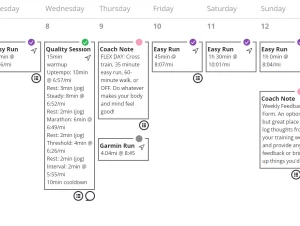
Making the switch from miles to minutes doesn’t have to be overwhelming. Here’s how to ease into it:
- Start With Easy Days: Make all your recovery runs time-based.
- Track Weekly Minutes: Add up total time instead of miles.
- Ignore the Pace: Focus on feel. Easy runs should feel easy.
- Use Time for Doubles: Run your second run of the day by minutes, not distance.