

I sort of just had a strange epiphany about tapers the other day. The realization was that there is a massive disconnect from how the outside world views and thinks about tapers, vs how coaches or maybe seasoned runners do.
Table of Contents
The Big Disconnect: What Runners Think Tapers Are
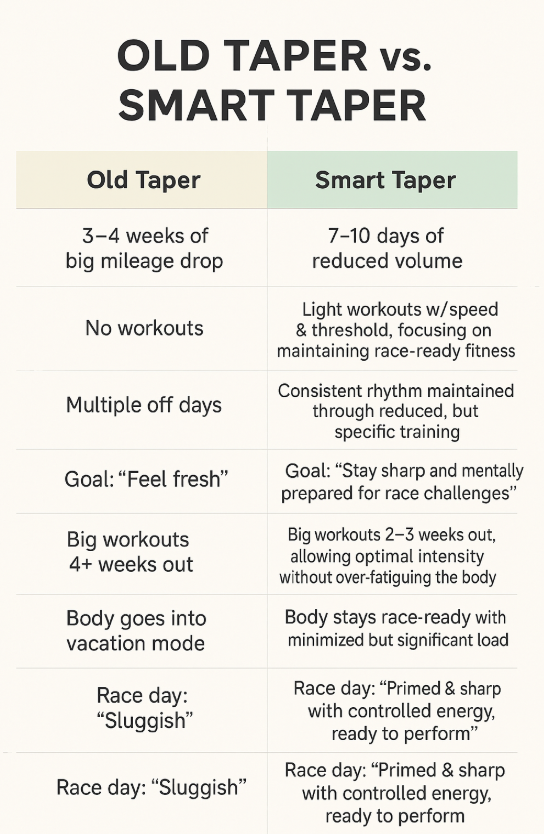
I’m a part of a few coaching groups, where a couple of us running coaches get together and talk shop and share ideas. We started talking about tapers the other day and we were all weirdly in lock-step agreement. Somewhat rare for us. Just about all of us utilize approx a 10 day taper but with some quality all the way down close to race day. Just about every single one of us have BIG if not our biggest hardest/longest workouts 2 or 3 weeks out. And just about every single one of us said that our athletes are always surprised and a little nervous by this and they always think tapers are supposed to be long and extreme. Like 3-4 weeks of super low mileage, maybe even a handful of off days to get EXTRA fresh, and the biggest baddest long runs being farther away from the race so that there’s no residual fatigue.
And to that I would say, “Nah”.
Why Big Dramatic Tapers Don’t Work
I’m not exactly sure why that is, maybe the free marathon plans floating around on google painted this picture, maybe there was a famous book that outlined tapers in this way. I’m not sure, but I do know that we all sort of know that big dramatic tapers, on average, aren’t as successful. The main reason is, our body rises and falls to the demand of our training load and stimulus, when it can. It gets used to certain rhythms. Use it or lose, it in a way. MUSCULAR TENSION. If you talk to enough runners, most will have a story about how they tapered really well, mileage cut in half, no workouts, rested like crazy, and they got to the race and felt like crap. They couldn’t wake up, they never got going, they felt sluggish, or just a bit off. Often the reason for that is, when we slash our training load by too much, our bodies go into rest and vacation mode. Our bodies are smart enough to know when we aren’t consistently utilizing certain aspects of our fitness or our physiology. So it quits priming those systems. Why? Because our biology is remarkably efficient and lazy. Your lungs are not going to prime your aerobic threshold system if that system hasn’t been touched in weeks. Our bodies don’t prepare systems we haven’t been using because that would be a waste on energy.
Every system has a certain time frame of when it starts to shut down, but we know that some of the processes around speed can fizzle in less than a week. Aerobic threshold isn’t far behind. So when you chop your training volume way down and stop touching those systems, they start fizzling right when you need them most.
How Does the Long Run Change in a Taper?
The long run is usually the first thing people think about cutting way down in a taper, but the truth is it doesn’t just disappear—it shifts. The distance, structure, and intensity depend on the race you’re training for.
For a 5k or 10k, the “long run” during taper might just be a steady 60–75 minutes with a few short pickups sprinkled in. The goal is to keep some rhythm without piling on fatigue. For the half marathon, most athletes still touch something in the 8–12 mile range the weekend before. For the marathon, that number might be 10–14 miles one week out, with controlled sections at marathon pace.
The common theme across all race distances is that you don’t want to abandon the long run completely. As one coach put it: “I don’t like to not have anything long with seven days to go. Even if it’s scaled down, I want that rhythm.” Short enough that recovery is easy, but long enough that your legs don’t forget what it feels like to move smoothly for an extended stretch.
Rhythm Over Rest
That word—rhythm—really is the key. We’re not trying to reinvent training in the final weeks, we’re just trimming it. The structure stays the same: workouts on the same days, long runs on the same days, easy days the same. One coach explained: “I want to stay in my rhythm for as long as I can. I almost want to feel like I’m training through my marathon. That’s how late I’ll push the drop-off.”
That’s why the old-school three- or four-week mega-taper doesn’t really work. Another line that stuck with me: “I hate those big four-week tapers. That’s just a recipe for being flat. You don’t want to go into a race flat.” And that matches what so many runners feel when they back way off too soon—they lose the edge.
How Should You Feel Going Into Race Week?
Here’s the surprising part: you don’t want to feel amazing for weeks on end before a marathon. That’s usually a sign you’ve over-tapered. What you want is just enough freshness at just the right time.
One of the guys in our group said it best: “Less running is also a stress. If you drop too much, your body gets sleepy. You don’t want to go into the race flat.” That’s why we still do small workouts even in race week—maybe some marathon pace reps, maybe some short pickups—just enough to keep the system awake.
Ideally, you start to feel good 2-4 days out. By the day before, you should feel excited, sharp, and ready. That little bit of tension in the legs is a good thing. As one coach said: “I’m way more concerned about muscle tension and flatness than I am fatigue. Small levels of fatigue are actually a good thing—they keep you snappy.”
It’s All About Showing Up Ready
So we slowly start to drop things, we keep in smaller amounts of speed and threshold work so that the body stays engaged, but there’s a small enough drop in training loaded that we can achieve peak performance. For some folks it’s 2-3 weeks, some it’s only 6-7 days of a reduced training load. But we know where that puts on average to start from to help athletes run their best race. At the end of the day that is always the goal; help athletes run their best!